Bank size is a math problem, not a guess. For events, a common planning guideline is one restroom per 50 guests over roughly four hours, with more units added for longer runtimes or where alcohol is served — a…
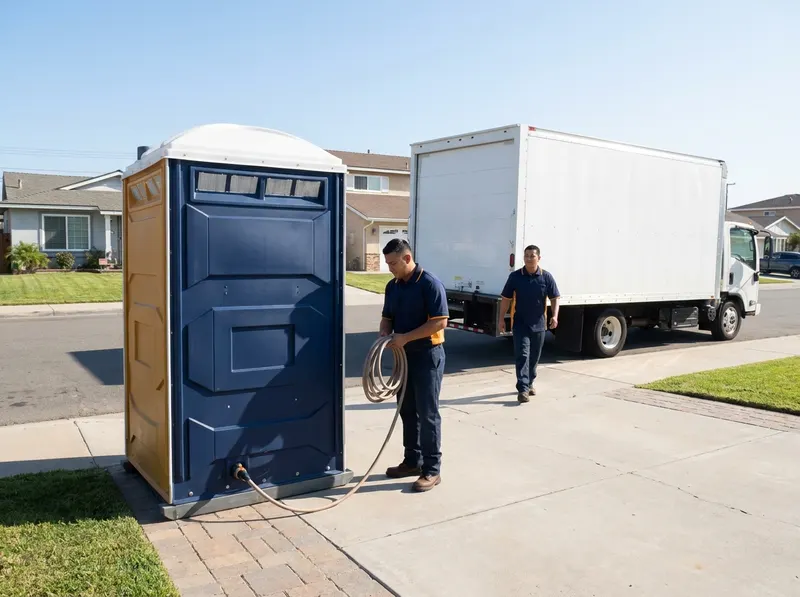
Bank size is a math problem, not a guess. For events, a common planning guideline is one restroom per 50 guests over roughly four hours, with more units added for longer runtimes or where alcohol is served — a 400-guest reception in Rohr Park or a tournament day at an Eastlake community field lands at 8 to 10 units rather than the 4 people usually expect. On construction sites, the widely used rule of thumb is one unit per 10 workers on a 40-hour week, which is why a framing crew ramping up in Millenia or Otay Ranch often outgrows a single unit within a phase. Tell us the headcount and hours; we will size the bank to it and say plainly if you are ordering more than you need.
A single unit fits small crews, short one-day gatherings, and driveway remodels. A bank fits anything with a queue. The trade-off is space and access: a 6-unit run needs roughly 40 to 50 feet of usable frontage plus door clearance, and the service truck has to get within about 25 feet of the units because pump hoses only reach so far. That is the deciding factor on real Chula Vista sites. Broadway corridor and Northwest Chula Vista lots often have alley-only rear access, so a bank goes along the fence line instead of the yard. Castle Park's older narrow streets and the sloped cul-de-sacs in Bonita Long Canyon and Rolling Hills Ranch force placement decisions on grade — banks need a level pad, so we set them on the flattest usable stretch, not the prettiest one. Paved plaza edges and podium parking near Millenia usually work well; soft turf near the Otay Valley Regional Park trailheads and lower Sweetwater Summit Regional Park approaches can rut after rain, so we look for compacted decomposed granite or asphalt within reach.
Layout follows crowd flow. For events at Bayside Park and along the Chula Vista Bayfront, we set banks perpendicular to the main walking path so the queue forms parallel to traffic rather than across it, and keep the bank out of the prevailing onshore breeze line from food service. At least one ADA-accessible unit in every public bank is standard practice and often required by the permitting body — it needs a firm, level approach and a clear path, so it anchors the end of the run rather than getting squeezed into the middle. Hand-wash stations or sanitizer stands sit at the exit end of the bank, not the entrance, so the line moves one direction. For multi-day events at Southwestern College lots or the athlete training center area, servicing is scheduled overnight or before gates open so trucks are never crossing pedestrian areas.
Servicing is the part that decides whether a bank stays usable. Each unit in the bank gets pumped, rinsed, restocked with paper, and treated on a set cadence — weekly is standard for job sites, and multi-day or high-traffic events usually need daily or twice-daily service, which we quote up front rather than as a surprise line item. If your Rancho del Rey, Terra Nova, or Sunbow project adds crew mid-term, we can add units to an existing bank in the same week and keep the whole set on one service schedule and one invoice. Delivered on schedule. Serviced on schedule.
Every job gets a firm, written price after a free on-site visit.
Tell us about your multi-unit restroom bank placement job in Chula Vista and we'll send a clear, written quote — usually the same day.
 CleanWave Toilet Solutions